How can academic work engage with and support biocultural conservation?
This dimension of the Knowledge Platform reflects a network of academic collaborators asking a simple question: what does it mean for universities and researchers to support biocultural conservation without directing it? The focus is on academia itself — its role, responsibilities, and capacity for change. The perspective is grounded in practice, shaped by the experience documented in the Biocultural Conservation in Practice section, and oriented by a principle drawn from Indigenous Māori scholarship: academia should be on tap, not on top.
On Tap, Not On Top is a position paper by 24 co-authors — Indigenous and non-Indigenous researchers, educators, and practitioners from institutions across the Americas, the Pacific, and beyond. It calls on academic institutions to recognize Indigenous knowledge systems as central, not peripheral, and to move beyond inclusion toward transformation in how knowledge is produced, valued, and shared.
The statement is grounded in epistemic justice: the recognition that diverse ways of knowing are legitimate and foundational. It identifies Territories of Life as knowledge centers that academia must recognize and engage. It invokes Two-Eyed Seeing (Etuaptmumk) as a practical model for engaging Indigenous and Western knowledge systems together.
The phrase "on tap, not on top" captures the posture this calls for: available, supportive, and responsive to community priorities and timelines — without directing, setting the agenda, or claiming ownership of the knowledge produced.
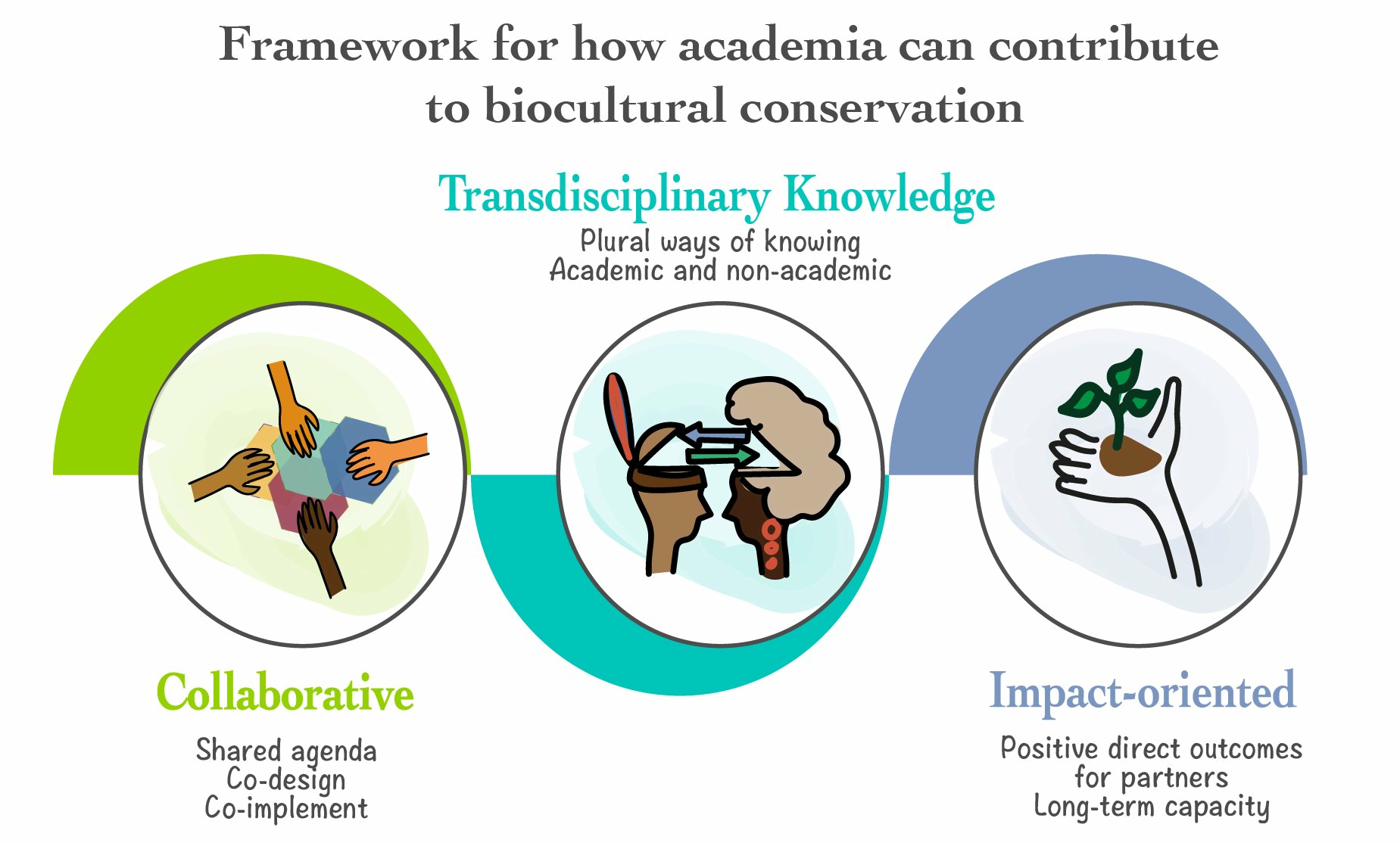
Academia can contribute through multiple pathways, including teaching, research, co-production of knowledge, and the development of tools and concepts that are grounded in real-world processes. On Tap, Not On Top identifies three principles and approaches for academia to contribute to biocultural conservation. These build on an earlier review and analysis of collaborative, transdisciplinary, and impact-oriented academic work, and are reinforced by recommendations developed through dialogue with Indigenous and practitioner voices at the Weaving Knowledge for Biocultural Conservation forum (COP16, Cali, Colombia, 2024).
Together, these sources converge on the same domains from different perspectives: what must change, how work can be shaped by community priorities, and how institutions can begin.
These contributions are most meaningful when they remain connected to territorial realities, and when they circulate back into practice in accessible and usable forms.
Research, teaching, and outreach must be designed and carried out with Indigenous Peoples and local communities. This means respecting community priorities and timelines, engaging knowledge holders and Elders as partners, and ensuring that communities retain governance over the knowledge produced.
Co-design requires restructuring how academic work is conceived from the outset. It depends on relationships built on trust, reciprocity, and recognition of cultural authority and protocols. Communities are co-investigators, and long-term commitment matters more than project cycles.
The COP16 dialogue reinforces this: academic initiatives must begin by understanding and aligning with the institutions, practices, and forms of knowledge that sustain territory and cultural identity. Effective collaboration is rooted in strengthening these existing systems.
Braiding interweaves knowledge systems, generating understanding that cannot emerge from any one system alone. It is distinct from transdisciplinarity, which can still privilege academic frameworks, and from additive co-production, which places knowledge systems side by side without transforming either. Academic institutions must recognize Indigenous knowledge systems as foundational rather than supplementary.
This requires engaging with diverse forms of knowledge creation and transmission, including everyday practices, ceremonies, traditional medicine, language, and lived relationships with territory. Territories are knowledge centers, not field sites. Language is central — both in sustaining Indigenous knowledge systems and in avoiding frameworks that reproduce colonizing assumptions.
The COP16 recommendations add two key dimensions. First, biocultural research must make space for multiple ways of expressing knowledge, including through practice, ritual, and material culture. Second, educational processes must be co-developed, taking place across different settings — classrooms, communities, and the territory itself — and involving multiple generations.
Academic work in biocultural conservation should be evaluated by whether it produces outcomes that directly benefit the communities involved. These outcomes include strengthened territorial governance, deeper relationships with lands, waters, and more-than-human beings, capacity building, and long-term resilience.
This reorients academic rigor toward outcomes that serve those engaged in the work. It also requires changes in academic systems — including funding structures, evaluation criteria, and publication norms — to recognize co-produced and community-oriented contributions.
The COP16 recommendations highlight an additional dimension: initiatives for knowledge co-creation must include a legal component, and legal processes affecting territories must recognize Indigenous and local knowledge as legitimate. Mechanisms for protecting traditional knowledge must be controlled by communities, and academic and state institutions must support its inclusion in legal and governance processes affecting territory — where Western technical knowledge has traditionally been the only form considered.
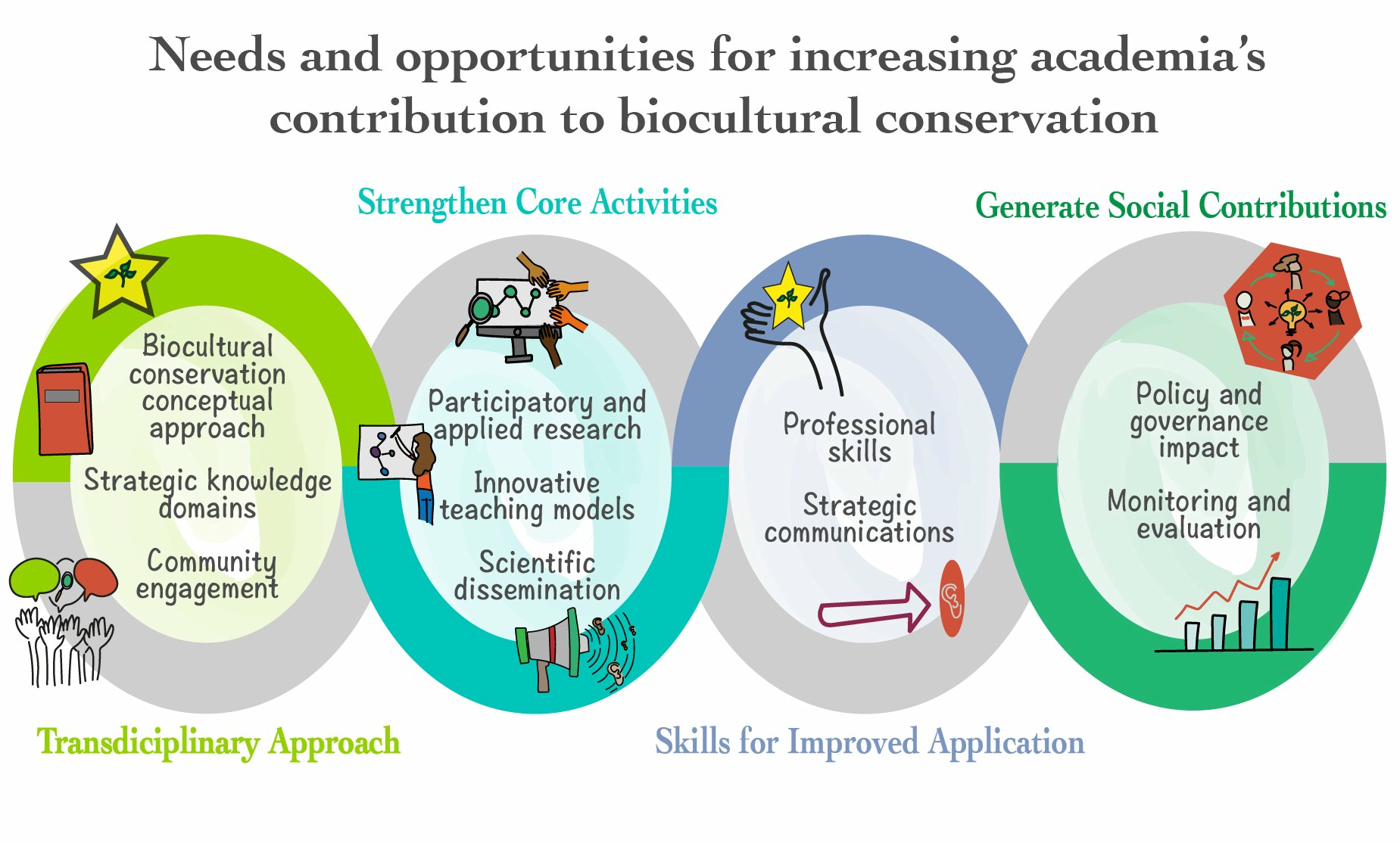
These three strategies translate into academic practice through specific institutional pathways — in research, teaching, professional development, communications, and policy engagement. The diagram below maps these pathways. A fuller treatment, including detailed analysis and examples from leading academic programs, is available in the white paper →
The ideas presented here are the product of a collaborative network of 30+ researchers, educators, and practitioners from institutions across the Americas, the Pacific, and beyond. The network includes both Indigenous and non-Indigenous scholars — among them members of the Muisca, Secwepemc, and Cherokee nations — and spans fields including ecology, education, law, linguistics, anthropology, and Indigenous knowledge systems. Network member profiles are available on the platform.
This is a community of shared commitment: individuals working to transform how academic institutions engage with Indigenous Peoples and biocultural conservation.
On Tap, Not On Top is a call to action, not a final word. This platform is conceived as an evolving space for dialogue, reflection, and co-construction on how academic institutions can support biocultural conservation, in ongoing exchange with the experiences documented in Biocultural Conservation in Practice.
Members of this network are generating a growing body of work that puts these ideas into practice — including intercultural education, co-research methodologies, and institutional partnerships. Webinars, presentations, and collaborative reflections are accessible through the platform's archive.
This library is intended to expand through continued contributions and dialogue among collaborators. Contributions are also welcome from Indigenous and local community members, practitioners, researchers, and others engaged in biocultural conservation.
Areas of engagement include experiments in partnership and co-research; responses to evolving policy frameworks such as the Convention on Biological Diversity and IPBES; critical reflection on how academic structures — curricula, reward systems, funding models, and publishing norms — may need to change; and emerging questions arising from practice, including the relationship between academic knowledge production and the direct-funding agenda advanced by Indigenous communities.
To contribute reflections, critiques, or related work, please visit the Contributions page.