Practice
Experiences, strategies, and lessons from the field
Biocultural conservation is grounded in the practices of Indigenous Peoples and local communities — in territory, culture, and collective governance.
Explore practice →Biocultural conservation is emerging as a practical strategy for addressing interconnected challenges of biodiversity conservation, climate stability, and social justice. Grounded in the worldviews, knowledge systems, governance, and territorial relationships of Indigenous Peoples and local communities, biocultural approaches connect ecological integrity with cultural continuity and socioeconomic well-being. This platform focuses on how biocultural conservation can contribute to real-world solutions, and is organized around a Theory of Change that explains how actions grounded in territory, values, knowledge, and partnership can lead to outcomes at local, regional, and global scales.
The Theory of Change presented here was co-constructed through dialogue among Indigenous and local communities, conservation practitioners, and academic researchers, drawing on their experiences and shared vision. It describes how biocultural approaches can generate outcomes at the intersection of biodiversity conservation, climate stability, livelihoods, and social justice — and, in many territories disrupted by colonization, dispossession, and extraction, how they support the restoration of biocultural relationships, not only their conservation.
At its core, the model recognizes that territories are living socio-ecological systems, shaped by the interaction of ecological dynamics, cultural practices, and social organization. It highlights the relationships between local stewardship, territorial processes, knowledge systems, governance, and cross-scale partnerships. Biocultural conservation is not envisioned as a linear sequence of interventions but as a holistic approach: supporting territorial integrity and governance, enabling dialogue and co-production across knowledge systems, and linking local action with broader institutional and policy frameworks.
Because many territories carry long histories of dispossession and harm, biocultural conservation often involves not only sustaining what remains but repairing relationships with land, knowledge, and governance. Outcomes emerge when rightsholders can assert and exercise their authority over their territories, and when enabling conditions across scales support these efforts. The interplay of local action and partnerships with context, power dynamics, and historical trajectories are explored further in the Biocultural Conservation in Practice section.
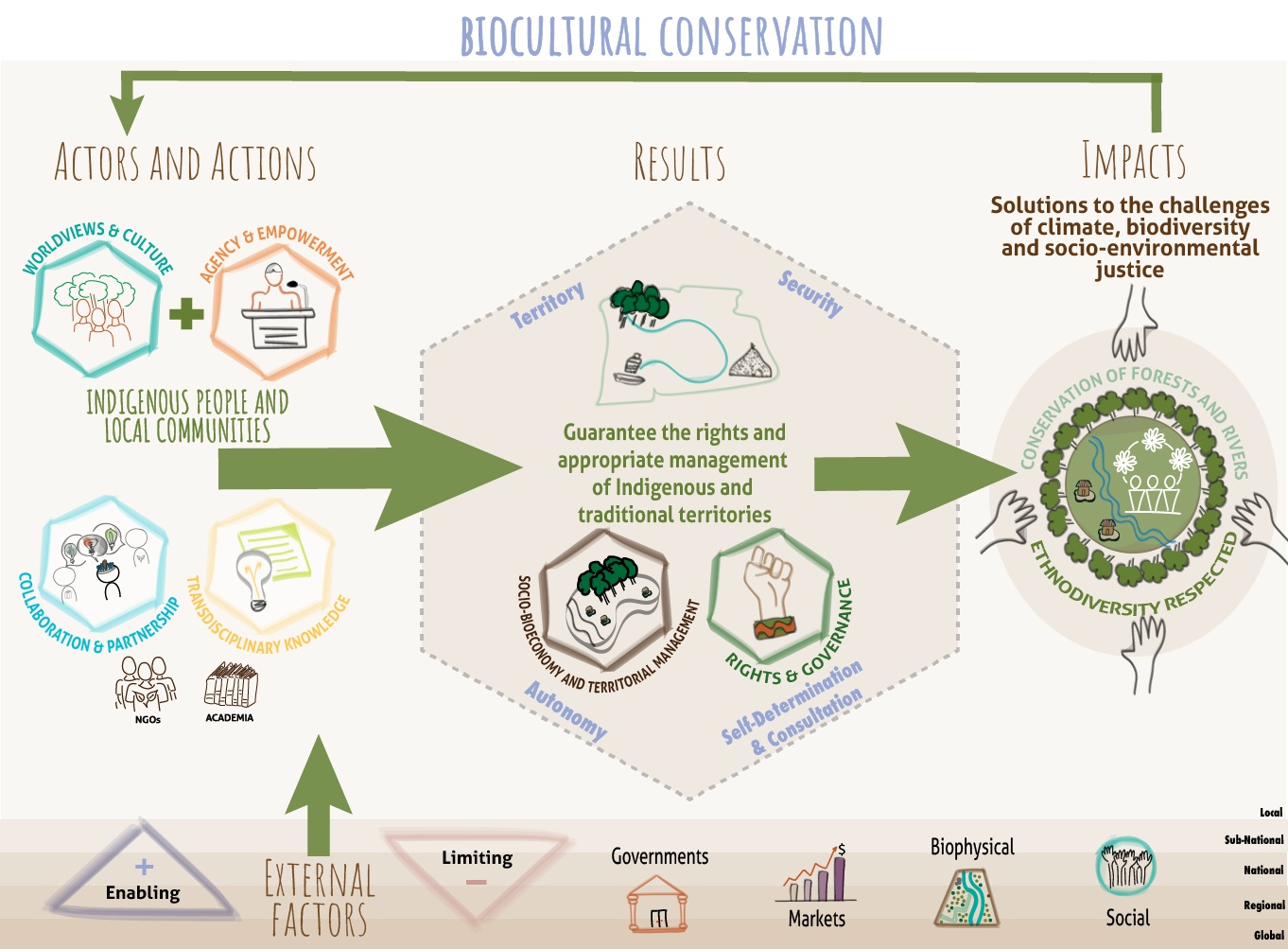
Biocultural conservation is an approach that recognizes the interdependence of biological and cultural diversity. Nature and culture are not separate domains, but deeply interconnected and mutually sustaining. Many of the world's most biodiverse landscapes reflect long-term interactions between people and ecosystems, shaped through systems of knowledge, practice, and governance.
The concept has evolved over time — from early recognition of overlapping patterns of biological, cultural, and linguistic diversity, to a deeper focus on biocultural heritage: the cultural practices and local ecological knowledge that sustain ecosystem processes. Over the past decade, it has increasingly been articulated as a set of biocultural approaches that connect conservation, governance, and knowledge systems in applied contexts.
Biocultural conservation is grounded in two fundamental premises:
Interdependence of biological and cultural diversity. Effective conservation requires integrated strategies across ecological systems and cultural dimensions, including knowledge systems, spirituality, and language.
Indigenous and community agency. Local communities with sovereign territories and strong cultural identity are key protagonists of conservation. Agency is the point of departure, not an outcome.
A substantial proportion of the world's remaining biodiversity is found within territories managed or inhabited by Indigenous Peoples and local communities. These areas are often among the most effectively conserved, reflecting long-standing systems of stewardship and governance.
Recognition of this has led to growing support for biocultural approaches within international policy frameworks, conservation organizations, and donor communities. This reflects a gradual and uneven shift toward approaches that integrate ecological, cultural, social, and economic dimensions, and that recognize Indigenous and community leadership as central to conservation and sociobioeconomic outcomes.
Buen Vivir is a powerful orienting vision: living well in harmony with nature, community, and spirituality. It is one of many cultural articulations of well-being as relational — inseparable from ecological integrity and cultural continuity — that biocultural approaches seek to honor rather than consolidate into a single model. The goal of biocultural conservation, as articulated by Indigenous and community organizations, is to implement Life Plans that achieve Buen Vivir.
Biological, linguistic, and cultural diversity are deeply interconnected. This interdependence is at once an observable reality — ecosystems shaped by cultural practice, cultural and linguistic systems evolving in relation to the living world — and a way of understanding the world: for many Indigenous Peoples and local communities, nature and culture are not separate domains to be balanced, but a single fabric of relationships and responsibilities. Biocultural approaches engage both registers, recognizing that how people understand their relationship with the living world shapes how they act within it.
Indigenous Peoples and local communities are key protagonists of biocultural conservation — not only as stewards of biodiversity, but as bearers of the knowledge, governance, and decision-making authority through which territories are sustained. Where interdependence describes how the living world is understood, agency concerns how communities act on that understanding: through self-governance, territorial management, and the exercise of collective rights.
Territory is the grounding concept that connects all others. It is where ecological, cultural, social, livelihood, and spiritual processes are lived together, and where knowledge systems are embedded and enacted.
Biocultural conservation is grounded in principles of knowledge and epistemic justice: the recognition that multiple ways of knowing are valid and necessary. This includes Indigenous knowledge systems, local ecological knowledge, and scientific research. Biocultural approaches emphasize dialogue among these systems and processes of co-production, rather than the integration of knowledge into a single dominant framework.
These principles have important implications for how academic institutions engage with conservation, and are further developed in the Academic Contribution dimension.
The platform is organized around two complementary dimensions.
Conservation in Practice brings together experiences, strategies, and lessons from the field. It is grounded in the practices of Indigenous Peoples and local communities, and in partnerships that support territorial processes and governance.
Academic Contribution considers how universities and researchers can support this work through partnership, co-research, and engagement with diverse knowledge systems, guided by the principle of "on tap, not on top."
The two dimensions share the same conceptual foundations, but practice is primary: it emerges from lived experience, while academic contribution is shaped through dialogue with practice and oriented toward supporting it.
Biocultural conservation is grounded in the practices of Indigenous Peoples and local communities — in territory, culture, and collective governance.
Explore practice →Academic work contributes when it is grounded in partnership and shaped by diverse knowledge systems.
Explore academic contribution →This platform is an evolving space for dialogue, reflection, and co-construction. Contributions are welcome from Indigenous and local community members, practitioners, researchers, and others engaged in biocultural conservation, including comments, suggested revisions, case materials, conceptual reflections, and related resources.
To suggest revisions or conceptual contributions, please visit the Contributions page.