When and how is biocultural conservation effectively implemented?
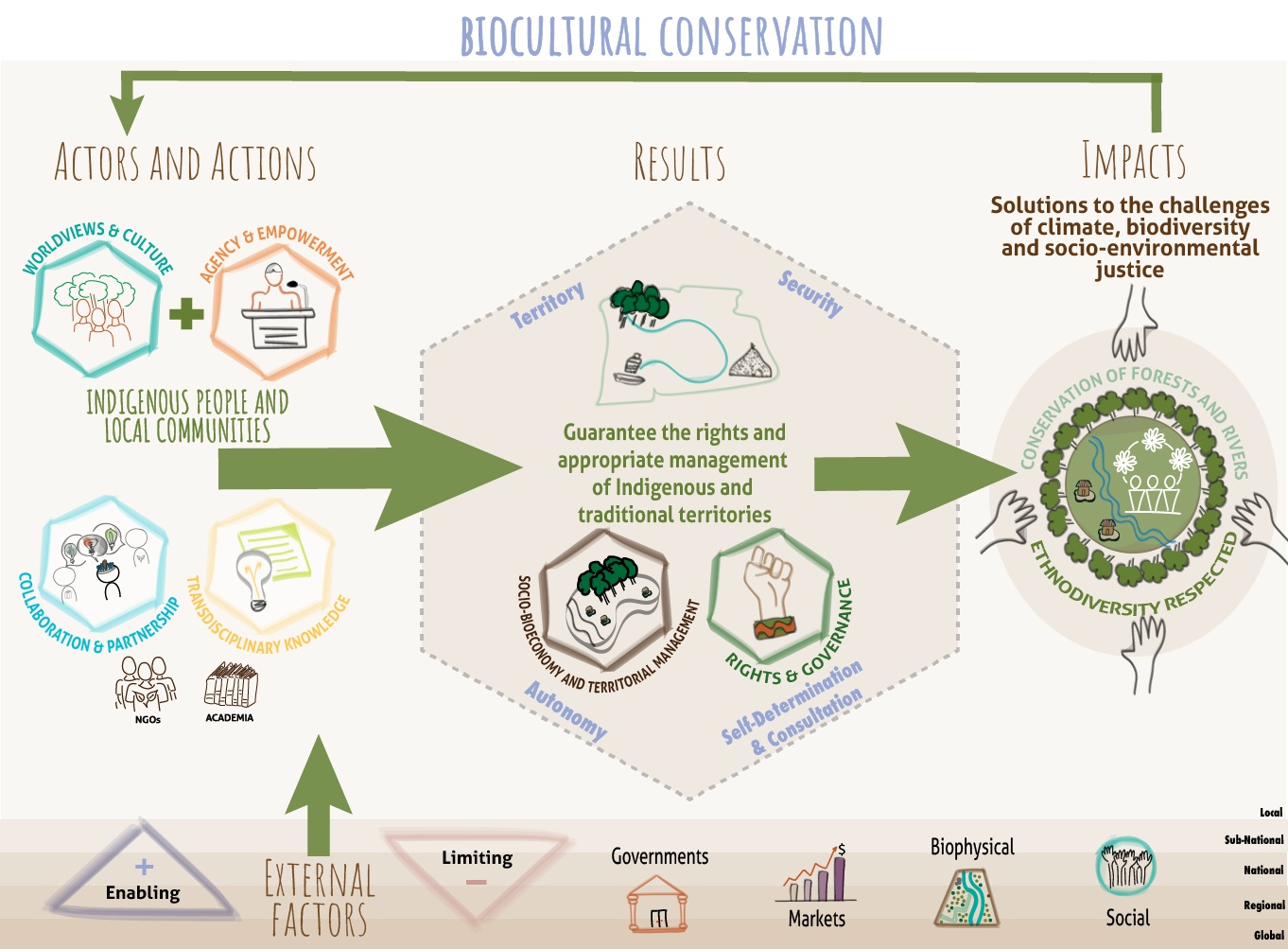
Biocultural conservation is practiced by Indigenous Peoples and local communities who govern, sustain, and restore their territories, knowledge systems, and ways of life — often in partnership with NGOs, researchers, and other allies. It rests on two premises: that biological and cultural diversity are interdependent and co-evolved, and that Indigenous Peoples and local communities are key protagonists of conservation. The Theory of Change below describes how these premises translate into action.
This Theory of Change was co-constructed by a network of Indigenous organizations, NGOs, and academic partners across five Amazon countries — through documentation of experience, a Voices from the Forest dialogue, and thematic working groups — and subsequently confirmed and refined through a systematic review of the worldwide academic literature on biocultural conservation.
It describes a progression from community agency to conservation outcomes. Indigenous Peoples and local communities are the central protagonists, drawing on their worldviews, culture, and self-governance. Their action is supported by two enabling strategies — collaboration and transdisciplinary knowledge — and produces results in two interconnected outcome domains: sociobioeconomy and territorial management, and rights and governance. External factors — governments, markets, biophysical conditions, and social dynamics — enable or constrain the entire process. The intended impact is the conservation of forests, rivers, and ethnodiversity, contributing to climate, biodiversity, and socio-environmental justice.
Each of these elements, elaborated below, represent recurring dimensions observed across different territories. They are not steps in a sequence, but interacting processes that take distinct forms in each context.
Biocultural conservation begins when communities exercise their own capacity to act — drawing on cultural identity, intergenerational knowledge, spirituality, and collective self-governance. A systematic assessment of 55 conservation strategies across four Amazon landscape mosaics showed that grassroots organizations were responsible for half of the most effective strategies while participating in less than a fifth of documented cases — evidence that innovation at the grassroots level, not standardized programs, drives outcomes. This is not empowerment conferred by outside actors but power that already exists within communities: the confidence that comes from cultural rootedness and the agency to shape decisions about one's own territory and future.
In practice, this means strengthening individual and collective capacities that integrate knowledge with mindset and culture — incorporating ethics, spirituality, artistic practices, and the transfer of knowledge both across generations and across cultures. The Yachaikury school in Caquetá, Colombia, is one expression: ethno-education born from the Inga people's own worldview, where education is collective and holistic. In Australia, NAILSMA supports Indigenous rangers in caring for Country through approaches that honor traditional ecological knowledge alongside contemporary tools.
Future work includes expanding intergenerational and intercultural education, supporting organizational capacity for communities to manage direct funding, and advancing the development of an Indigenous University.
Biocultural conservation depends on relationships among communities, NGOs, academic institutions, and sometimes government agencies. What distinguishes effective collaboration from extractive partnership is reciprocity, long-term commitment, trust, and awareness of power dynamics.
The Community of Practice and Learning model offers one tested approach: a polycentric network in which grassroots leaders, practitioners, and researchers learn together through regular exchange and co-produced research. Universities contribute through co-produced knowledge and convening, in the supporting posture the academic network describes as "on tap, not on top."
Future work focuses on building collaborative partnerships across regions and strengthening mechanisms for communities to lead rather than receive.
Conservation knowledge in a biocultural frame emerges from the reciprocal exchange of Indigenous, practitioner, and academic ways of knowing — diálogo de saberes. This is not an additive process but a transformative one: generating new intercultural knowledge that none could produce alone.
This requires both internal mobilization — sharing knowledge within and among communities — and external communication that makes Indigenous perspectives visible and politically effective. At least 14 different communication instruments are in use across the network, from community radio to international media to storytelling for public audiences, all grounded in Social and Behavior Change Communication theory that treats communications as a bottom-up process rooted in local context. Uldarico Matapí's shamanic geography of Chiribiquete demonstrates that territories themselves encode cosmological knowledge, reframing landscapes as carriers of meaning, not only ecological value.
Future work includes developing more rigorous methods for intercultural co-creation of knowledge and strengthening strategic communications capacity across the network.
Sociobioeconomy is an integrated Indigenous vision of well-being, production, protection, and monitoring — with complete respect for biodiversity and local cultures. It is not a Western economic concept applied to conservation. It integrates economics, biodiversity, and social dimensions based on a conception of human needs that includes subsistence, protection, affection, understanding, participation, creativity, identity, and liberty.
The operational framework is the Life Plan — a community-generated vision of Buen Vivir that articulates how a people wants to live in its territory. Territorial management under this framework includes ecological monitoring, agroforestry, resource management, locally adapted enterprises, and investment in communications infrastructure and renewable energy.
Future work centers on implementing existing Life Plans with a long-term perspective, integrating traditional and Western production systems, and developing value chains that respect traditional economic culture.
The defense and exercise of territorial rights are both a condition for biocultural conservation and one of its most important outcomes. Indigenous Peoples demand autonomy and self-determination, including free, prior, and informed consent. Fundamental rights are enshrined in constitutions and international agreements but widely violated in practice, requiring constant struggle through social mobilization and judicial engagement.
Governance extends beyond legal status to what the Territories of Life literature calls governance vitality: the living capacity of communities to take and implement decisions about their territories. Case studies of Indigenous resistance in Colombia and Bolivia demonstrate that internal governance processes — dialogue, unity, spiritual grounding — are the foundation of effective action, even when formal protections are incomplete. The financing architecture of conservation is itself a governance question: direct, community-governed financing, as articulated by the Shandia platform's seven principles, positions communities as key actors rather than beneficiaries.
Future work includes establishing an Observatory of Indigenous Human Rights for judicial defense, the active co-development of context-specific, community-defined indicators of well-being, and promoting dialogue with government and the private sector on Life Plan implementation.
The Theory of Change describes a pathway from community agency through territorial action to broader impacts: the conservation of forests, rivers, and ethnodiversity, and contributions to climate, biodiversity, and socio-environmental justice. For example, Indigenous lands and traditional community territories cover a quarter of the Amazon Basin; their effective protection is widely recognized as essential to meeting global environmental goals. But this protection cannot be sustained without support for the rights, governance, and self-determination of the communities who have maintained these landscapes. Conservation, in this framework, is not a constraint on human activity but an expression of a way of life — grounded in the pursuit of Buen Vivir.
The cases presented here illustrate how these processes come together in specific territories. They are drawn from documented experience across diverse regions, ecosystems, and governance systems, contributing both practical lessons and conceptual insights. Each reflects a particular configuration of actors, ecological conditions, and institutional contexts, highlighting both opportunities and constraints. This section will continue to grow as new cases are contributed to the platform.
Two cases of community resistance — Yunguillo in Colombia opposing road construction, and Mancomunidad in Bolivia opposing dam construction — analyzed through a decolonizing environmental justice framework. The study, co-produced with Indigenous researchers, reveals how communities draw on spirituality, collective governance, and internal unity to resist threats to territorial sovereignty.
Contributes: The four types of power as an analytical tool; spirituality as a source of empowerment; the reality that outcomes are contested and incomplete.
View case study → (under construction)
A partnership spanning more than 25 years between the Inga people and ACT in the Amazon foothills of Colombia. Achievements include the creation of Alto Fragua Indi Wasi National Park, the Yachaikury ethno-education school, and resistance to road paving without prior consultation.
Contributes: A model of long-term, trust-based collaboration; ethno-education as practice; community-initiated conservation.
View case study → (under construction)
Uldarico Matapí Yucuna presents the rock art of Chiribiquete not as archaeological heritage but as living cosmological knowledge encoded in territory. Landscapes are carriers of meaning, spiritual practice, and intergenerational transmission.
Contributes: Territory as a knowledge system; the inseparability of conservation of place and conservation of knowledge.
View case study → (under construction)
A community-led initiative integrating the traditional moku land management system with contemporary conservation practice. He'eia demonstrates how Indigenous governance frameworks can serve as the foundation for ecological restoration.
Contributes: Indigenous governance as conservation infrastructure; island-based biocultural practice beyond the Amazon context.
Linguistic diversity as a dimension of biocultural conservation. Language carries ecological knowledge: plant names encode habitat relationships; seasonal vocabularies reflect landscape processes. Revitalization is simultaneously cultural continuity and knowledge preservation.
Contributes: Language as a vehicle for ecological knowledge; biocultural conservation beyond land management.
View case study → (under construction)
A national forum bringing together over 100 participants to articulate Indigenous priorities for conservation. The I-Tracker program supports Indigenous land managers in using digital tools for environmental monitoring grounded in traditional knowledge.
Contributes: Indigenous-defined conservation priorities at national scale; integration of traditional knowledge with digital monitoring.
View case study → (under construction)
Biocultural conservation is practiced across regions, ecosystems, and governance systems. The lessons it produces continue to evolve, and this platform is intended as an evolving space for dialogue, reflection, and co-construction.
Contributions are welcome from Indigenous and local community members, practitioners, researchers, and others engaged in biocultural conservation. New cases and materials will contribute to a deeper and more diverse understanding of how biocultural conservation unfolds in practice. Cases can be presented in diverse formats: a written narrative, a recorded conversation, or a facilitated dialogue. Five guiding prompts can help structure each contribution: the context and territory; the practice or initiative; enabling conditions and constraints; how knowledge and collaboration shaped the work; and what the case contributes to the broader understanding of biocultural conservation. Comments, suggested revisions, and conceptual reflections on the existing material are also welcome.
To share case-based experiences or related materials, please visit the Contributions page.